

The original 1999 Pokémon TCG Base Set pairs unmatched nostalgia with an iconic holo lineup, multiple early print variations, and a First Edition Charizard chase that still defines an entire era of collecting.
FoilWire verdict
| Artwork | 10.0 / 10 |
| Nostalgia Factor | 10.0 / 10 |
| Set Depth | 10.0 / 10 |
| Opening Experience | 10.0 / 10 |
| Top Chase Appeal | 10.0 / 10 |
Base Set is rougher and much simpler than the Pokémon TCG products that followed it, but almost every one of those limitations has become part of its identity. An absurdly recognizable holo lineup, genuine print-run history, fantastic checklist depth and perhaps the most famous chase card in the hobby make this the measuring stick: the first Pokémon set, and quite possibly still the best.
Five categories, each out of 10. The overall score is their equally weighted average. Select a category above to read the reasoning, or see how we score.

Quick Take
- Set / TCG: Pokémon Trading Card Game – Base Set, 102 cards.
- Release date: January 9, 1999, for the English Base Set.
- Product type: The first main English Pokémon TCG expansion, released through traditional booster packs alongside starter and theme deck products.
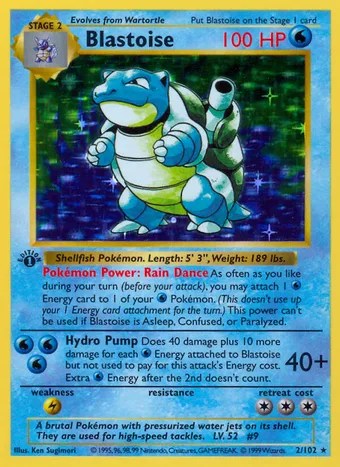
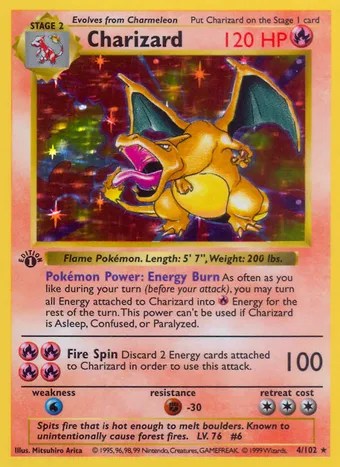
- Top chase: Charizard 4/102 Holo Rare from the First Edition print run, with Blastoise, Venusaur, Mewtwo, Raichu and the rest of the set’s classic holo lineup providing plenty of company.
Artwork


Base Set obviously cannot compete with a modern Pokémon release for full arts, alternate illustrations, etched textures and cards covered in enough foil to signal passing aircraft. It doesn’t need to. This is Pokémon stripped right back to the beginning, and that simplicity has become part of its charm. Charizard, Blastoise and Venusaur are immediately recognizable, while cards such as Mewtwo, Alakazam, Raichu, Gyarados and Zapdos give the holo lineup a remarkably strong visual identity.
The classic foil is restrained inside the artwork window rather than taking over the entire card, and the yellow borders, simple layouts and early Pokémon illustrations make a completed binder unmistakably Base Set. Even the commons have become memorable. Pikachu, Charmander, Squirtle and Bulbasaur do not need elaborate rarity treatments to look important here. The downside is fairly obvious: viewed purely against modern production, many cards are simple and some artwork can look positively tiny. But Base Set has something much harder to manufacture than texture or sparkle. It has identity. You can spot one of these cards from across the room. That counts for quite a lot.
Nostalgia Factor
Well, this one is almost unfair. Base Set is not a set trying to remind collectors of early Pokémon. It is early Pokémon. Charizard. Blastoise. Venusaur. Pikachu. Mewtwo. The original starters. Professor Oak. Bill. Energy cards that somehow make you remember sitting on a carpet sorting piles of cardboard. For a generation of fans, these are the cards that established what a Pokémon card was supposed to look like. The different early English printings make that history even more interesting.
First Edition cards carry the famous stamp, Shadowless cards retain the earlier layout without the stamp, Unlimited introduced the familiar drop shadow and heavier text, and a later Unlimited printing can be identified by its 1999-2000 copyright line. That gives collectors several distinct versions of essentially the same historic checklist to explore. Plenty of later Pokémon sets have deliberately reached backwards for nostalgia, sometimes brilliantly. Base Set does not have to reach anywhere. Everyone else is reaching back toward it.
Set Depth
Charizard gets so much attention that it is easy to forget just how deep Base Set actually is. There are 16 numbered Holo Rares, beginning with Alakazam and ending with Zapdos, although Machamp 8/102 has its own strange history because the familiar First Edition holo was distributed through the 2-Player Starter Set rather than normal Base Set booster packs. Take Charizard away and you still have Blastoise, Venusaur, Mewtwo, Raichu, Gyarados, Alakazam, Chansey, Ninetales, Nidoking and Zapdos sitting in the holo portion of the checklist. Then keep going. Dragonair is a non-holo rare.
Arcanine and Charmeleon are uncommons. Pikachu, Charmander, Squirtle and Bulbasaur give even the lower rarities recognizable Pokémon that people actually want in a collection. That is depth. The obvious knock is that some of the Rare Trainer cards were probably not what a kid wanted to see after tearing into a booster hoping for Charizard, and modern sets offer dramatically more elaborate rarity ladders. Still, Base Set rarely feels like one superstar surrounded by filler. Charizard is the headline act, certainly, but the supporting cast is ridiculous.
Opening Experience
Base Set packs were gloriously uncomplicated. Eleven cards. One rare slot. No reverse holo, no illustration rare, no secret rare hiding behind another rare, and no need for a flowchart to work out whether you had actually pulled something good. The rare slot carried the suspense, with a holo providing the standout reveal. And when the foil pattern caught the light, you knew immediately what had happened.
The simplicity cuts both ways. A non-holo rare or Rare Trainer could make a pack feel pretty flat, and there was no second shiny slot waiting to rescue you. Modern Pokémon openings are much busier and often give collectors more visual variety per pack. Base Set was harsher. But that is also part of why those holos felt so special. From a historical opening-design standpoint, it is difficult not to give the set full marks. This score is about how the product was designed to be experienced, rather than suggesting anybody should start tearing into surviving vintage packs today. Sometimes it is perfectly fine to let a 27-year-old booster sit there looking pretty.
Top Chase Appeal
There are chase cards, and then there is Base Set Charizard. The First Edition Holo Rare Charizard 4/102 is one of the defining Pokémon cards, full stop. It does not need a serial number, an alternate-art scene or five layers of texture. It is Charizard, breathing fire against that classic galaxy-style holo background, from the first English Pokémon TCG set, with the First Edition stamp sitting beside the artwork. That combination gives the card an identity few collectibles ever achieve. Better still, Base Set does not collapse once Charizard is removed.
First Edition Blastoise and Venusaur are natural companion chases, while Mewtwo, Raichu, Alakazam, Gyarados and the other original holos give collectors plenty of recognizable targets. There is also another layer to the chase because condition and print variation matter enormously to how these early cards are collected. That makes Base Set fascinating without needing us to turn the review into a price guide. Charizard anchors the product, but the real achievement is that pulling several different holos can still feel like pulling an important piece of Pokémon history.
Sources
- Bulbapedia: Base Set: English release date and card checklist.
- Bulbapedia: Machamp (Base Set 8): Starter-set distribution and print history.
- Bulbapedia: Booster pack: Eleven-card vintage booster format and pack artwork.
- CGC: Shadowless Charizard Earns a Coveted CGC Pristine 10 Grade: First Edition markings and the distinction between Shadowless and Unlimited cards.
How we score
Each category is scored out of 10. Add the five category scores and divide by five for the overall FoilWire Score, shown to one decimal place. Each category contributes 20 percent. The score reflects our editorial judgment from a collector’s perspective.
For this vintage review, Opening Experience evaluates the original product design. It does not report a new opening of vintage packs or assess whether opening them today is worthwhile.
- 9.2–10.0: Legendary — A standout release with broad collector appeal, strong identity, and exceptional overall execution.
- 8.4–9.1: Memorable — A very strong set with real strengths, even if one or two areas keep it from top-tier status.
- 7.5–8.3: Noteworthy — A worthwhile release with clear positives, though it may be more niche or uneven overall.
- 6.3–7.4: Mixed — A set with some interesting elements, but noticeable weaknesses in depth, excitement, or long-term identity.
- 0–6.2: Forgettable — A release that struggles to stand out and offers limited lasting appeal outside a narrow audience.
